
Alaska in my Bones
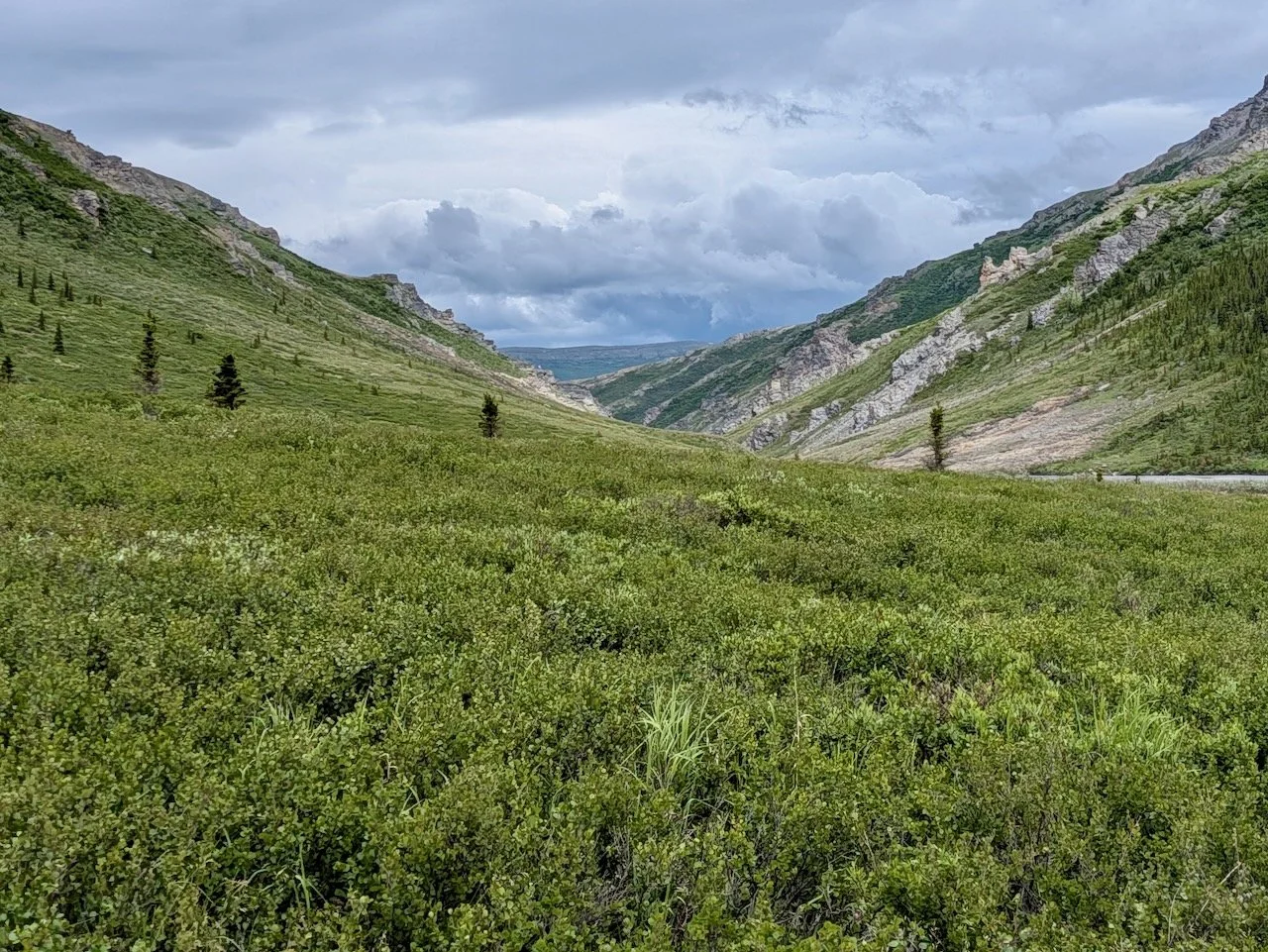
Alaskan Valley. Photo by Tim Lindeman.
I know where I am going after I die. I don't mean that in a spiritual sense—like many Quakers, I am agnostic about whether there is an afterlife. I mean that I know where my remains will go. My body will be cremated and someone in my family will go up in a small plane and scatter my ashes over Sleeping Lady, to be with my people. My niece and nephew will look across the inlet and think of me when they see the mountain, like I thought of my grandmother who died six weeks before I was born.
My Southern husband likes to tease me by saying that I am not from America. He's not wrong. My mother was born in Anchorage four years before Alaska became a state. I had the kind of childhood that would be familiar to anyone from my hometown: climbing Flattop at midnight on Summer Solstice, using the money I earned from a lemonade stand to buy salty-sweet strips of smoked salmon from 10th & M Seafood, my mom waking me up on a clear fall night to see the Northern Lights.
For people from there, Alaska is The Great Land and everywhere else is Outside. When Alaskans meet each other in the lower 48, the first question we ask is, "Where did you go to high school?"
This weeds out the people who say they are from Alaska but really moved there as adults. It also helps us establish where each person fits in the complicated social network of Anchorage. When I tell someone that I went to East High, that tells them I probably grew up middle class and lived in Midtown. I might add that I grew up in Downtown, a block away from Inlet View Elementary School. We might talk about how that school was just torn down and rebuilt, but we will probably move straight to trying to find people in common: a cousin who went to East or a friend who lives near the Lagoon. For people who were born in Anchorage, there is always a point of connection eventually.
Anchorage was established in 1914 and the first White settlers lived in a tent city near Ship Creek. Those settlers included my great-grandparents, Jack and Ray Laurie, Jewish immigrants who had fled the pogroms of Lithuania. My other great-grandfather, J. Vic Brown, Sr., came to Alaska from England by way of the Orphan Train through Canada. These desperately poor immigrants decided to raise their families in Alaska, and my family has been living in Anchorage continuously ever since. My siblings and I have all been recognized by strangers because we look so much like our parents and grandparents.
People tend to think of Alaska as a red state, and it is, but not for the reasons you might think. As I write this, Mary Peltola is favored to become the first Native Alaskan in the U.S. Senate, after serving as the first Native Alaskan in Congress. Her platform is "Fish, Family, and Freedom," which makes perfect sense to Alaskans and baffles the rest of the country.
In a place where building resources are expensive and the building season is short, Alaskans reuse buildings in creative ways. I grew up going to a Thai restaurant in a former Dairy Queen (you could still see where the sign had been) and a sushi spot in an old Taco Bell building. There are Quonset huts everywhere.
In a century, Anchorage became one of the most religiously and ethnically diverse cities in the country. In addition to having ten percent Native Alaskans, immigrants came from all over the world and military families came and decided to stay. When I went to East High, there were 36 languages spoken in the school. It consistently ranks in the top 10 most diverse high schools in the U.S. My classmates sang in COGIC choirs, went to early-morning LDS seminary, and ate matzah PB&J sandwiches during Passover. Our school had a dedicated wing and program for Native Alaskan students. My parents' church has a sizable group of Sudanese refugees, and Anchorage has one of the largest Hmong communities in the world.
People act like Anchorage is just a stopping point before getting to the real Alaska, and tend not to give it a lot of thought, but that is a mistake. In many ways, Anchorage is the American city. Since leaving Alaska, I have rarely been in such religiously and culturally diverse spaces. In a time when there is so much polarization and people tend to live in their own racial, political, and religious bubbles, Anchorage is an example of how people can live side by side and care for each other across differences.
This is my Anchorage, and I hope it will be yours too.